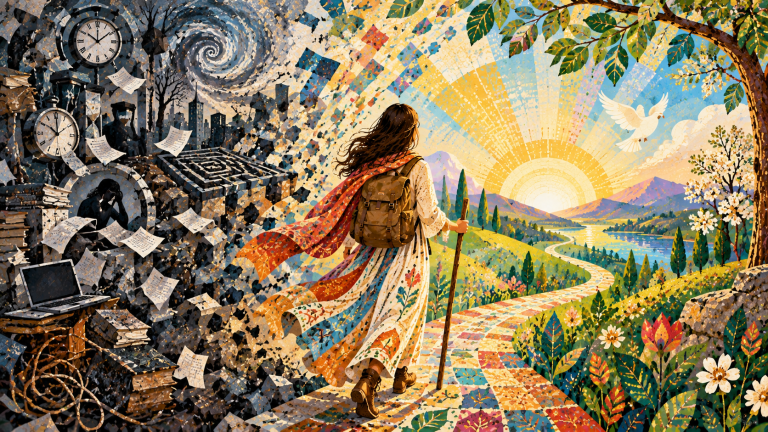

What Love Creates Cannot Be Lost
Loss is one of the most difficult experiences we encounter. A relationship changes, someone we love is no longer physically present, a season of life ends, or a home, friendship, opportunity, or dream that once seemed permanent disappears. When these things happen, it can feel as though something meaningful has been taken from us forever.
Yet A Course in Miracles offers a very different way of looking at loss. It invites us to reconsider what is truly capable of being lost and what remains untouched by change. Perhaps some of what we experience as loss belongs to the changing forms of life, while the love expressed through those forms reaches much deeper.
The Difference Between Love and Its Form
We often measure love through form. We associate it with people, places, experiences, relationships, and circumstances, and because all of these can change, we naturally begin to believe that love itself can disappear with them. But perhaps the form through which we experienced love and the love itself are not the same thing.
Think about someone who profoundly affected your life. Perhaps that person encouraged you when you doubted yourself, forgave you when you made a mistake, cared for you during a difficult period, or simply made you feel understood. Circumstances may eventually change, people may move away, relationships may take different forms, and eventually every physical life reaches an end.
But something may remain because of what that love awakened within you. Perhaps you became more compassionate, learned how to forgive, discovered courage you did not know you possessed, or learned through someone’s kindness how to become kinder yourself. The circumstances through which love reached you may change, but what was awakened through that experience can continue shaping the way you live.
This distinction matters because we often mourn the disappearance of a form and conclude that everything associated with it has disappeared as well. Yet the meaning, growth, healing, and love that came through an experience may continue influencing us long afterward. The form may have passed, but the effect of genuine love can remain.
What Is Real Is Not Defined by Time
A Course in Miracles presents creation as fundamentally different from the temporary forms we perceive. It describes creation as the extension of Love and teaches that what God creates remains unchanged beyond time, protected from separation and harm. In this view, what is truly created by Love does not share the temporary nature of the forms we see around us.
This challenges the way we normally understand reality. We usually consider something real because we can see it, touch it, possess it, or remember when it happened, yet everything we perceive physically changes. Bodies age, buildings deteriorate, possessions disappear, and circumstances shift. If permanence depended entirely upon physical form, permanence would be impossible.
The Course points instead toward a reality beneath appearances, one that does not depend upon time for its existence. Love belongs to that deeper reality, which means the disappearance or transformation of a particular form does not necessarily tell us what has happened to the love we experienced through it.
This does not mean that every human relationship is perfect or that everything we call love actually represents love. Human relationships can contain attachment, fear, expectation, dependency, resentment, and misunderstanding alongside genuine care. The invitation, then, is not simply to preserve every relationship or memory, but to recognize what was truly loving within them and allow that love to continue through us.
Loss Still Hurts
A spiritual understanding of love should never require us to pretend that grief does not hurt. When someone dies, when a relationship ends, or when something deeply meaningful changes, the emotional experience can be profound. Recognizing an enduring spiritual reality does not mean suppressing sadness, denying what has happened, or pretending that the absence of someone we love does not matter.
We can grieve the form while gradually discovering that love was never confined to the form. This distinction does not eliminate sorrow, but it can change the way we understand it. Instead of asking only, Why was this taken from me?, another question can slowly emerge: What did this love create within me that is still here?
That question does not erase grief, but it may reveal something grief sometimes hides. Perhaps the person is no longer sitting beside you, yet the kindness they taught you remains. Perhaps the relationship ended, yet what you learned about forgiveness remains. Perhaps childhood is gone, yet the love received there continues shaping how you care for your own family. A moment may have lasted only minutes and still have changed the direction of an entire life.
The outward form may therefore pass while the effects of love continue. What was awakened through the experience can remain part of us, influencing how we think, how we respond to others, and how we choose to live.
Fear Says We Can Lose Everything
Much of our fear comes from believing that whatever gives us peace can eventually be taken away. If another person gives us our sense of worth, losing that person seems capable of destroying our worth. If possessions give us security, losing them appears capable of destroying our security. If circumstances give us peace, every change becomes a possible threat.
Fear therefore encourages us to hold tightly to form, as though keeping the form unchanged could guarantee that love will remain. Yet life repeatedly shows us that forms cannot be made permanent. People change, circumstances evolve, bodies age, and even the things we carefully preserve eventually undergo transformation.
A Course in Miracles asks us to distinguish between what changes and what is real in the deepest spiritual sense. This does not mean that nothing changes in our human lives; clearly, things change constantly. Rather, it suggests that change in form does not have the power to alter what God created or destroy the reality of Love.
That distinction can gradually loosen fear’s grip. We no longer need every circumstance to remain exactly as it is in order to trust that what was genuinely loving within it had meaning.
Love Extends
There is another way to understand why love does not simply disappear: genuine love extends beyond the moment in which it is given. Someone may show you compassion during one of the hardest periods of your life, and years later you may recognize another person going through something similar and respond with the same compassion you once received.
A parent’s patience can influence a child who later offers patience to someone else. A teacher’s encouragement can give a student confidence that eventually allows that student to encourage another struggling person. Someone may forgive us when we believe we do not deserve forgiveness, and through that experience we may discover that we are capable of extending forgiveness ourselves.
In this way, love continues even as its outward form changes. Its movement does not necessarily end where our awareness of it ends, because what we receive through love can become something we later extend to another person. We may never know how far a single act of compassion, patience, forgiveness, or kindness ultimately travels.
This reflects the Course’s understanding of Love as extending rather than diminishing itself. Love does not become smaller because it is given. When genuine love is received and then extended, what seemed to belong to one relationship or one moment becomes part of something much larger.
Remembering Differently
Memory can sometimes become another place where we try to preserve form. We revisit old conversations, photographs, places, and experiences because we fear that allowing them to fade somehow means losing the person or the love associated with them. There is nothing wrong with cherishing memories, but remembrance does not require us to keep yesterday perfectly intact.
We can allow the love we received yesterday to become part of how we live today. In this way, remembrance becomes more than looking backward; it becomes a way of extending into the present what was meaningful in the past.
Perhaps the deepest way to honor someone who taught us kindness is to become kinder. Perhaps the deepest way to remember someone who showed us forgiveness is to forgive. Perhaps the deepest way to honor someone who loved us well is to allow ourselves to love more freely because they were part of our lives.
Then memory becomes something living rather than merely an attempt to preserve what has passed. We honor love not only by remembering that it happened, but by allowing what it taught us to become visible through us.
What Remains
There will always be things in this world we cannot keep. We cannot stop time, prevent every goodbye, preserve every circumstance exactly as it once was, or avoid every experience of grief. Trying to make temporary forms permanent eventually brings us face-to-face with the limits of what we can control.
Perhaps peace begins when we stop asking temporary things to provide permanence. The deepest gifts of love may never have belonged to time in the first place. The kindness that changed us, the forgiveness that freed us, the compassion that softened us, and the truth that awakened something within us may appear through temporary circumstances while their meaning reaches far beyond those circumstances.
When we begin to understand this distinction, loss can look different without becoming insignificant. We may still miss someone, wish circumstances had unfolded another way, or grieve what is no longer physically present. Spiritual understanding does not require us to deny any of those experiences.
But beneath the grief, another recognition can gradually emerge. Love was present, and because it was present, something meaningful happened within us. If we allow what was given through love to continue shaping and extending through our lives, then what appeared to end in one form can continue expressing itself in another.
What Love truly creates is not measured by how long a particular circumstance lasts. Its reality is found in what it gives, what it awakens, and what it continues to extend. From this perspective, what Love creates cannot be lost.
A Quiet Reflection
Consider someone, something, or a season of life you believe you have lost. Instead of focusing only on what is no longer physically present, ask yourself:
What did love create in me through this person, relationship, or experience?
Perhaps it was courage, compassion, forgiveness, wisdom, or simply the knowledge that you were loved. Whatever comes to mind, consider one more question:
How can I extend that love today?
The form may have changed, but what you received through genuine love can still become part of what you give.
This reflection is inspired by themes found in A Course in Miracles, including its teachings on love, creation, perception, and the distinction between what is eternal and what changes within time. The Course describes creation as the extension of Love and as remaining unchanged beyond time.